
Sample: Tin-Essako (TE) 001 (~4.3 g) was found in Mali in 2020 and purchased by Jay Piatek in 2021. It was classified as a metal-rich ungrouped achondrite, with olivine and oxygen isotope (d18O=8.2810‰, d17O=3.718‰, avg. 3) compositions suggesting affinity to ureilites [1]. We studied one polished section (~187.7 mm2) of TE 001.
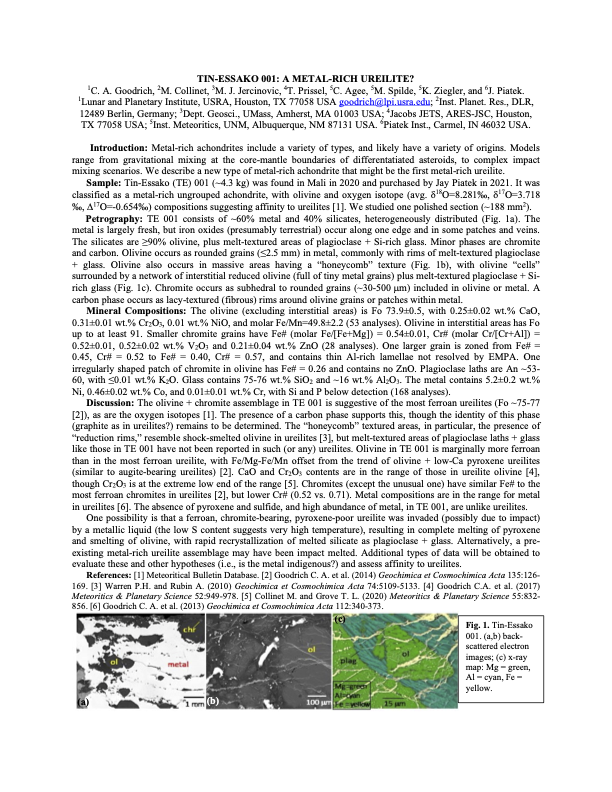
Petrography: TE 001 consists of ~60% metal and 40% silicates, heterogeneously distributed. The metal is largely fresh, but iron oxides (presumably terrestrial) occur along one edge and in some patches and veins in the interior. The silicates are dominantly olivine (≥90%), with melt-textured areas of plagioclase + Si-rich glass. Minor phases include chromite and carbon. Olivine occurs as rounded grains (up to ~2.5 mm) in metal, commonly with rims of melt-textured plagioclase + glass. Olivine also occurs in more massive areas having a “honeycomb” texture, with rounded olivine “cells” surrounded by an interstitial network of reduced olivine riddled with tiny metal grains, plus melt-textured plagioclase + Si-rich glass. Chromite occurs as subhedral to rounded grains; smaller grains (30-250 mm) are included in olivine and a few larger grains (400-500 mm) are isolated within metal. A carbon phase occurs as lacy-textured rims around olivine grains in metal, or small patches within metal.
Mineral Compositions: The olivine (excluding interstitial areas) is Fo 73.9±0.5, with 0.25±0.02 wt.% CaO, 0.31±0.01 wt% Cr2O3, 0.01 wt.% NiO, and molar Fe/Mn=49.8±2.2 (53 analyses). Olivine in interstitial areas has Fo up to at least 91. Smaller chromite grains have Fe# (molar Fe/[Fe+Mg]) = 0.54±0.01, Cr# (molar Cr/[Cr+Al]) = 0.52±0.01, 0.52±0.02 wt.% V2O3 and 0.21±0.04 wt% ZnO (28 analyses). One larger grain is zoned from Fe# = 0.45, Cr# =0.52 to Fe# = 0.40, Cr# =0.57, and contains thin Al-rich lamellae not resolved by EMPA. One irregularly shaped patch of chromite included in olivine has Fe# =0.26 and contains no ZnO. Plagioclase laths are An ~53-60, with ≤0.01 wt.% K2O. Glass contains 75-76 wt% SiO2 and ~16 wt% Al2O3. The metal contains 5.2±0.2 wt% Ni, 0.46±0.02 wt.% Co, and 0.01±0.01 wt.% Cr, with Si and P below detection (168 analyses).
Discussion: The olivine + chromite assemblage in TE 001 is similar to the most ferroan ureilites (Fo ~75-79 [2]), as are the oxygen isotopes [1]. The presence of a carbon phase supports this, although the identity of this phase (graphite as in ureilites?) remains to be determined. The “honeycomb” textured areas, in particular, the presence of olivine “reduction rims,” resemble shock-smelted olivine areas in ureilites [3], but interstitial melt-textured plagioclase laths + glass like those in TE 001 have not been reported in such (or any) ureilites.
Olivine in TE 001 is marginally more ferroan than in the most FeO-rich ureilite, with Fe-Mg-Mn composition offset from the trend of olivine + low-Ca pyroxene ureilites similar to augite-bearing ureilites [4]. CaO and Cr2O3 contents are in the range of those in ureilite olivine [ ] , though Cr2O3 is at the extreme low end of the range [5]. Chromites (except the unusual one) have similar Fe# to the most ferroan primary chromites in ureilites [2], but distinctly lower Cr# (0.52 vs. 0.71). Metal compositions are with the range for metal in ureilites [7]. The absence of pyroxene and sulfide, and the high abundance of metal in TE 001, are unlike ureilites.
One possibility is that a ferroan, chromite-bearing, pyroxene-poor ureilite was invaded (possibly due to impact) by a metallic liquid (low S content suggests very high temperature), resulting in complete melting of pyroxene and smelting of olivine, with rapid recrystallization of melted silicate as plagioclase + glass. Alternatively, a pre-existing metal-rich ureilite assemblage may have been impact melted. Additional types of data will be obtained to evaluate these hypotheses (i.e., is the metal indigenous?) and assess affinity to ureilites.
Document ID
20220007199
Acquisition Source
Johnson Space Center
Document Type
Conference Paper
Authors

Date Acquired
May 9, 2022
Subject Category
Meeting Information
Meeting: 85th Annual Meeting of The Meteoritical Society
Location: Glasgow, Scotland
Country: GB
Start Date: August 14, 2022
End Date: August 19, 2022
Sponsors: Meteoritical Society
Funding Number(s)
Distribution Limits
Public
Copyright
Portions of document may include copyright protected material.
Keywords
No Preview Available