NASA Logo

NTRS

NTRS - NASA Technical Reports Server

Press Enter or click the Search button to begin your search.

Back to Results
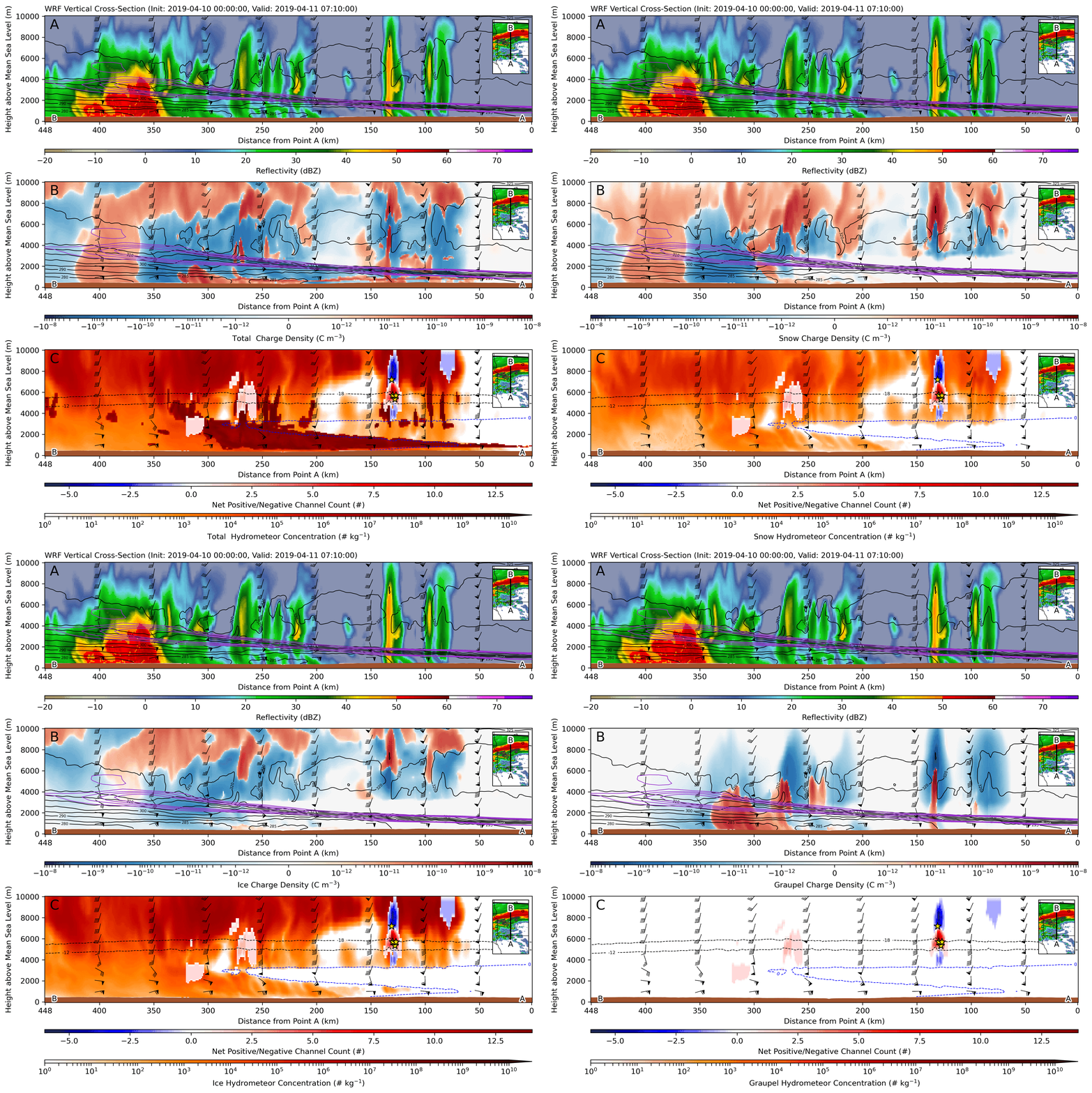
Explicitly Resolving Lightning and Electrification Processes from the 10-12 April 2019 Thundersnow Outbreak The 10-12 April 2019 thundersnow (i.e., lightning within snowfall) outbreak was examined via ground- and space-based lightning observations and was simulated using a numerical weather prediction model with an explicit electrification parameterization. When compared to observations, the simulation propagated the synoptic snowband two to six hours faster while also exaggerating the 3-D reflectivity structure. Throughout the event, the simulation produced 1,733 thundersnow flashes which was less than what was observed by ground- and space-based lightning sensors. In general, simulated thundersnow flashes were spatially offset from the largest reflectivities within the synoptic snowband and tended to occur within elevated convection that traversed isentropically along the top of mid-level frontogenesis. These simulated thundersnow flashes were associated with a tripole charge structure with ice/snow hydrometeors contributing most to the main negative charge region. Both simulated and observed thundersnow flashes initiated in conditionally unstable environments. Lastly, a conceptual model was developed to explain the spatial separation between the largest reflectivities in the snowband and the occurrence of thundersnow. It is hypothesized that the spatial offset of thundersnow initiation from the reflectivity cores within the synoptic snowband arose from a thermal circulation – induced by mid-level frontogenesis – that advects positively charged ice/snow hydrometeors towards the surface and creates a nearly homogeneous vertical charge structure.
Document ID
20240008191
Acquisition Source
Marshall Space Flight Center
Document Type
Accepted Manuscript (Version with final changes)
Authors
Sebastian S Harkema ORCID
(University of Alabama in Huntsville Huntsville, United States)
Edward R Mansell ORCID
(NOAA National Severe Storms Laboratory Norman, United States)
Alexandre O Fierro ORCID
(BP (United States) Houston, Texas, United States)
Lawrence D Carey ORCID
(University of Alabama in Huntsville Huntsville, United States)
Christopher J Schultz ORCID
(Marshall Space Flight Center Redstone Arsenal, United States)
Toshi Matsui ORCID
(University of Maryland, College Park College Park, United States)
Emily B Berndt ORCID
(Marshall Space Flight Center Redstone Arsenal, United States)
Date Acquired
June 27, 2024
Publication Date
June 26, 2024
Publication Information
Publication: Journal of Geophysical Research: Atmospheres
Publisher: American Geophysical Union/Wiley
Volume: 129
Issue: 13
Issue Publication Date: July 16, 2024
ISSN: 2169-897X
e-ISSN: 2169-8996
Subject Category
Geosciences (General)
Meteorology and Climatology
Funding Number(s)
CONTRACT_GRANT: 80NSSC20K1623
CONTRACT_GRANT: 80MSFC22M0004
Distribution Limits
Public
Copyright
Portions of document may include copyright protected material.
Technical Review
Single Expert
Keywords
lightning
thundersnow
snow
electrification
WRF